
What Water Damage Restoration Costs in Lancaster, CA (and How to Compare Quotes)
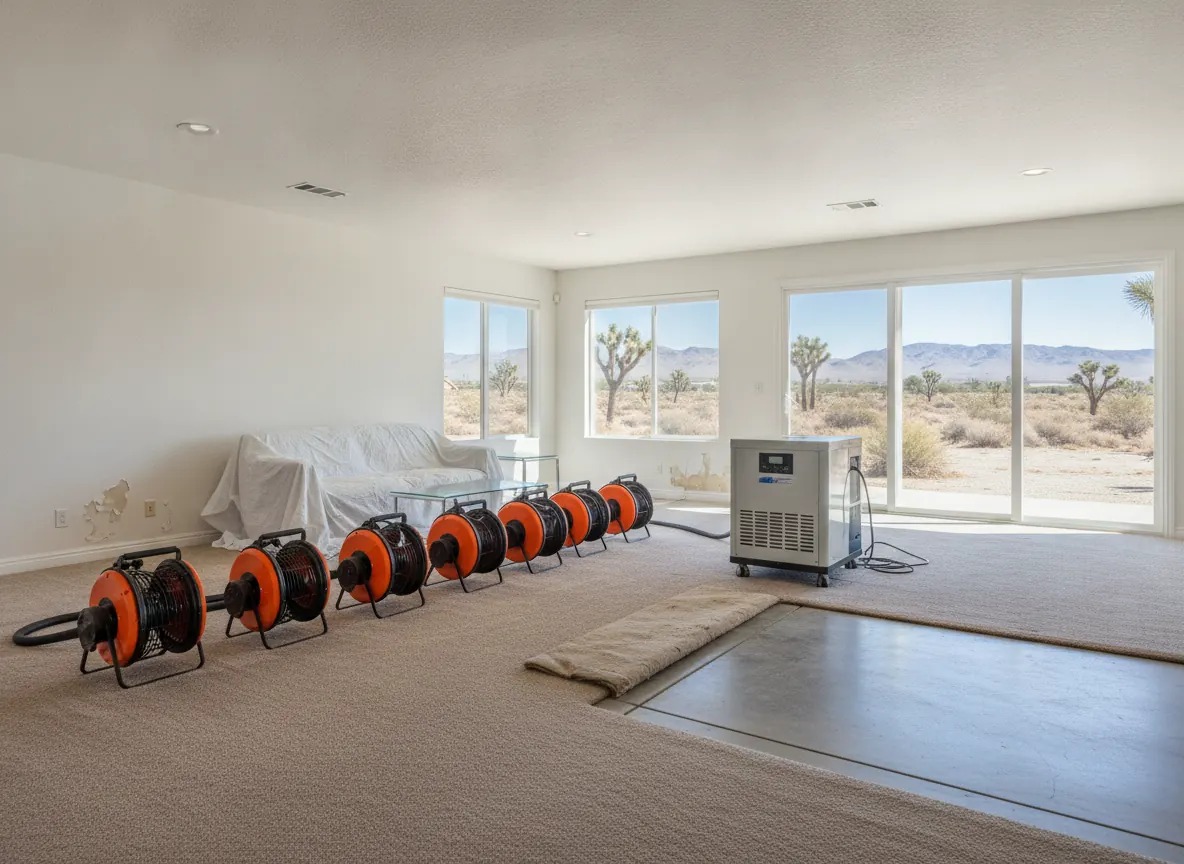
Short answer: published national cost guides put a typical water damage restoration job at about $2,000 to $6,000 (2025–2026: HomeGuide, Angi, Fixr, This Old House), but your price in Lancaster, CA depends on the category of water, how much material got wet, how long drying takes and what has to be rebuilt. No published source gives a reliable Antelope Valley average, so the written quotes you get are what count. This guide explains what drives the number and how to compare quotes line by line.
For the full table of typical national ranges and a planning calculator, see the water damage restoration cost guide for Lancaster, CA. These are estimates, not quotes.
Antelope Valley Fire & Water Damage is a free quote service, not a restoration company, a contractor or an insurance adjuster. It doesn't do cleanup, drying, mold work or repairs, and it isn't affiliated with the City of Lancaster, the City of Palmdale, Los Angeles or Kern County, the Los Angeles County Fire Department, the Kern County Fire Department, FEMA, your utility or your insurance company. Describe the damage once, and independent local restoration companies, which may pay to receive requests, can reply with quotes. You sign any contract directly with the company you choose and pay that company directly.
Before you collect quotes.
- Stop the water first. Shut off the water at your main valve, and turn off power to wet areas only if you can reach the panel without standing in water.
- Photograph every wet room and the source before anything is moved.
- Call your insurer and ask whether its adjuster needs to inspect before work starts.
- Write down when the water started and which rooms it reached. Every company will ask.
What drives the cost of water damage restoration
- Category of water. Clean water from a supply line (Category 1) costs least to handle. Gray water from a washer or dishwasher (Category 2) costs more. Sewage and floodwater (Category 3) cost the most, because contaminated drywall, insulation and carpet usually have to come out. See sewage backup cleanup and flash flood cleanup.
- Class, or how wet. A wet corner of carpet is a small job. Soaked walls, ceilings, hardwood or plaster take more equipment and more days.
- Square footage. Many line items are priced per square foot, so measure the wet area or ask the company to show its measurements.
- Drying days. Each day of fans and dehumidifiers adds equipment charges. Dry desert air can help materials dry faster here, but that depends on the job, and readings decide when drying is done.
- Materials removed. Cutting out drywall, baseboard, pad or cabinets adds labor and disposal.
- Contents. Moving, cleaning or packing out furniture and belongings is often a separate line.
- Timing. Many restoration companies take after-hours emergency calls; ask about after-hours rates, since nights and weekends often cost more.
- Repairs and rebuild. New drywall, paint and flooring are usually billed separately from the drying, and sometimes by a different contractor.
Costs that come from someone else
A restoration company handles the water, not the cause. After a freeze, the plumber fixes the pipe and bills for it separately; see burst and frozen pipe water damage. If your home has a rooftop swamp cooler and it leaked through the ceiling, the cooler or roof repair is billed separately by an HVAC tech or roofer. Ask each restoration company which parts of the job it will not do, so you can budget for them.
How to compare quotes line by line
Two quotes with the same total can describe very different jobs. Ask for a written scope from each company and compare these items:
- Affected area. Do both quotes measure the same rooms and square footage?
- Water category and class. Do they agree on how contaminated and how wet it is? If not, ask why.
- Equipment. How many air movers and dehumidifiers, for how many days, and at what daily rate?
- Removal. Exactly which materials come out, and how much?
- Moisture readings. Will the company take readings each day and share drying logs you can give your insurer?
- Antimicrobial and cleaning steps, especially for gray water or sewage.
- Contents work and storage, if any.
- What's not included. Rebuild, plumbing, roofing, permits and debris hauling.
A low quote that leaves out removal or cuts drying short can cost more later if mold shows up. A high quote isn't always better either. The goal is a scope that matches the damage, with readings to show it worked.
California rules that affect your quote
- In California, a repair job of $1,000 or more, any job that needs a building permit, or any job where the worker brings a crew must be done by a CSLB-licensed contractor (Business and Professions Code §7048). Most real water losses pass $1,000.
- Check any contractor's license at cslb.ca.gov or call 800-321-2752 before you sign.
- California caps a contractor's down payment at $1,000 or 10% of the contract, whichever is less, and payments can't get ahead of the work (B&P §7159.5).
- For 180 days after a declared emergency, California generally bars contractors from raising repair and cleanup prices more than 10% over what they charged before (Penal Code §396).
- If you sign a contract to repair damage from a declared emergency, such as a fire or flood, you have seven business days to cancel (B&P §7159; Civil Code §1689.6).
The guide to choosing a restoration company in California covers license lookups and red flags in more detail.
Insurance and your quote
California homeowners have the right to choose their own licensed contractor. Your insurer can't require you to use a particular company (Insurance Code §10103.5; 10 CCR §2695.9). If your own contractor's estimate is higher than your insurer's, California rules require the insurer to pay the difference, name a repairer who will do the work for its estimate, or adjust your contractor's estimate (10 CCR §2695.9(d)).
Deductibles. In California, a contractor generally can't offer you a discount meant to cover your insurance deductible unless the work matches what your insurer approved (Penal Code §551). A quote that quietly "absorbs" your deductible is worth questioning.
Only a public adjuster licensed by the California Department of Insurance can be paid to handle your claim for you. Verify licenses at 1-800-967-9331. Questions about a claim? The California Department of Insurance hotline is 1-800-927-4357. This is general information, not legal or insurance advice.
Getting quotes through Antelope Valley Fire & Water Damage
You can send a request any time. Describe the damage once, with photos if you have them, and independent local restoration companies serving Lancaster, Palmdale and the Antelope Valley can reply. You compare their written scopes, choose one if you want to, and sign and pay that company directly. For what the work usually includes, see water damage restoration and water extraction.
Frequently asked questions
How much does water damage restoration cost in Lancaster, CA?
Published national cost guides put a typical job at about $2,000 to $6,000 (2025–2026: HomeGuide, Angi, Fixr, This Old House), but there is no reliable Antelope Valley average. Your price depends on the water category, how much got wet, drying days and repairs. Written quotes from companies that see the damage are what count.
Why are two water damage quotes so different?
Usually because they describe different work. Compare the measured area, the water category, how many fans and dehumidifiers for how many days, which materials come out, whether moisture readings are included, and what is left out, such as rebuild, plumbing or roofing. Ask each company to explain any gap.
Is the plumber or roofer included in a restoration quote?
Usually not. A restoration company handles the water and drying. The plumber who fixes a burst pipe, and the HVAC tech or roofer who fixes a leaking swamp cooler or roof, normally bill separately. Ask each restoration company what it won't do so you can budget for the rest.
Can a contractor charge more after a declared emergency?
Only within limits. For 180 days after a declared emergency, California generally bars contractors from raising repair and cleanup prices more than 10% over what they charged before, unless they can show their own costs went up (Penal Code §396). This is general information, not legal advice.