
Does
- Takes your request any time, online or by phone
- Passes it to independent local restoration companies
- Offers free, plain guides to costs, California rules and first steps
From the first minutes after a leak, flash flood or fire to final moisture readings and permits: what to do at each step, what to ask, and what to get in writing.
Get a Free Quote Call (877) 265-2390
Call to be connected with a local restoration company. The number is a toll-free call-connection line, not a local Antelope Valley number and not a restoration company.
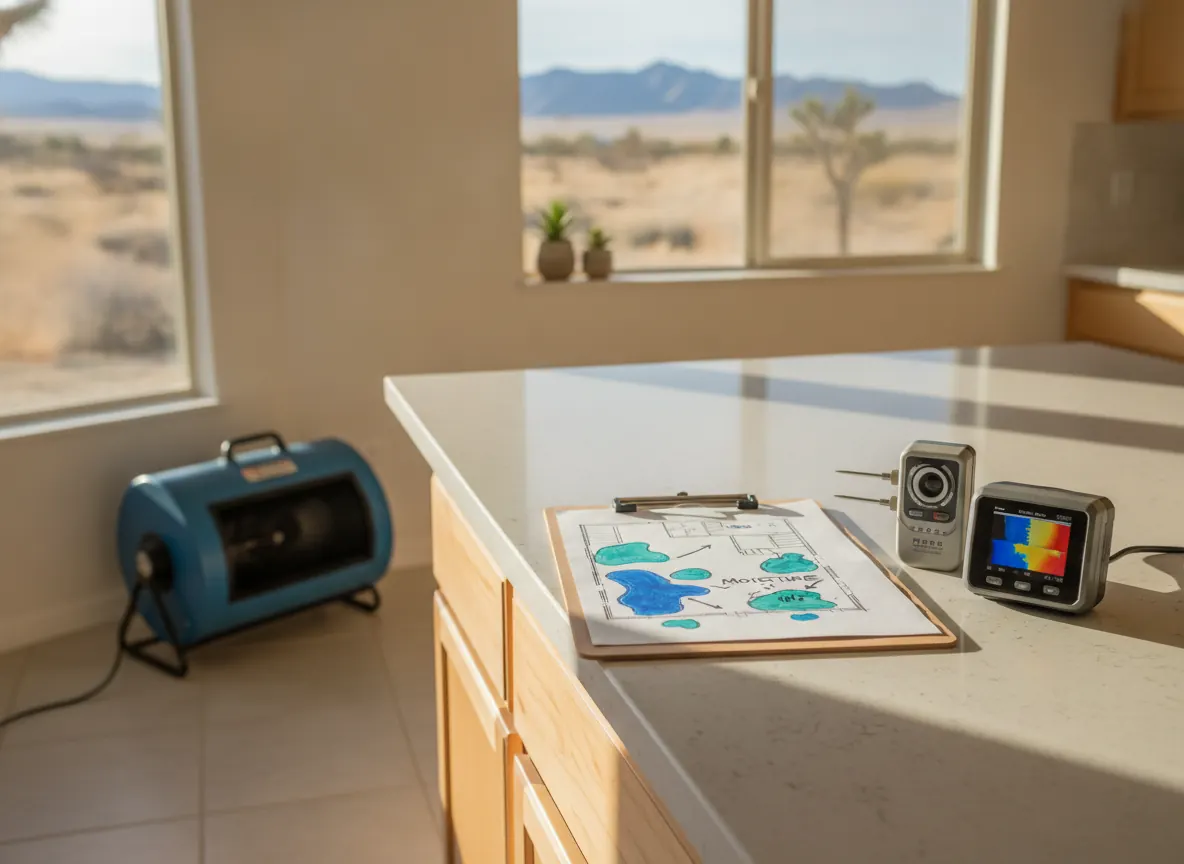
The water damage restoration process in Lancaster, CA follows the same path on most jobs, whether it’s a pipe that split on a freezing night, a swamp cooler leak through a ceiling, runoff from a summer storm across a tile entry, or soot through a kitchen. Knowing the steps makes the phone calls calmer and the quotes easier to compare.
Antelope Valley Fire & Water Damage connects owners and renters in Lancaster, Palmdale and across the Antelope Valley with independent local restoration companies. Antelope Valley Fire & Water Damage does not inspect, dry, clean or repair anything, and it does not check licenses. The companies that reply assess the damage, set the price and do the work. You decide whether to hire any of them, and you sign with and pay that company directly.
Need prices first? See the cost guide and calculator, or read the FAQ.
Steps 1 to 4 are yours. Steps 5 to 9 involve the companies that reply and the one you choose.
If there’s fire, smoke or a gas smell, get out and call 911 first. After a fire, don’t go back inside until the fire department says it’s safe. Around water, turn off power to wet areas only if you can reach the panel without standing in water. Don’t walk or drive through floodwater, and keep kids and pets away from sewage.
For a burst pipe or appliance leak, shut off the water at your main valve, and call your water provider if the leak is on their side of the meter. For a fire, the fire department is the first call. Smell gas? Leave, then call 911 and your gas utility from outside. Never touch a downed power line: call 911, then SCE at 1-800-611-1911.
Before anything is moved or thrown out, photograph every affected room, the water line on the walls, damaged belongings and the source. Then call your insurer, or your landlord if you rent. Ask the adjuster whether they need to inspect before repairs start, and keep every receipt.
Use the form or call. Say what happened, when, which rooms are affected, whether it’s clean water, gray water or sewage, whether the water and power are off, and whether a claim is open. Photos help.
Antelope Valley Fire & Water Damage passes your request to independent restoration companies that serve your area, and they contact you directly. Companies may pay to receive requests; the service is free to you. Reply times depend on the companies.
Ask each company for a written scope and estimate, the category and class of water it found, its drying plan with daily moisture readings, its CSLB license number, and who prepares the insurance paperwork. In California, a home improvement contract over $500 must be in writing (B&P §7159).
The company you hire removes standing water, takes out materials that can’t be saved, and sets up air movers and dehumidifiers. Moisture readings each day show whether drying is on track. Smoke and soot jobs get cleaning and odor treatment at this stage.
Once materials are dry, drywall, flooring, cabinets and paint go back in. Lancaster and Palmdale run their own building departments; unincorporated towns go through LA County Public Works or Kern County. If a repair needs a building permit, California requires a licensed contractor for it, whatever the price.
Before walls close up, ask for final moisture readings showing materials reached a dry standard. Collect the drying logs, photos, invoices, the signed contract and any permit for your insurer and your records.
If there’s fire, smoke or a gas smell, get out and call 911 first. Smell gas? Leave the house, then call 911 and SoCalGas at 1-800-427-2200 from a safe distance, or your own gas utility if you have a different one. Don’t flip switches on the way out.
Pipe burst? Shut off the water at your main valve, then call your water provider if the leak is on their side of the meter. Depending on your address, that may be LA County Waterworks District 40, Palmdale Water District, Quartz Hill Water District, Cal Water or Rosamond Community Services District; the name is on your water bill. Find your shut-off before the first hard freeze.
For a flash flood, don’t walk or drive through moving water. Turn Around, Don’t Drown, and never drive into a flooded wash or dip in the road. Floodwater is contaminated, so wet drywall, insulation and carpet it reached usually have to come out. Don’t run gas appliances or electrical equipment that sat in water until a qualified technician checks them.
For a sewage backup, keep kids and pets out. In unincorporated LA County, the sewer lateral from your house to the main is the homeowner’s responsibility, so a backup may be a plumbing call first (LA County Public Works).
Specific guides: burst and frozen pipes, sewage backups, flash flood cleanup, fire damage and board-up and wildfire smoke and ash.
Before repairs start, ask your insurer’s adjuster whether they need to inspect first, take photos and keep receipts (California Department of Insurance). California homeowners have the right to choose their own licensed contractor. Your insurer can’t require you to use a particular company (Insurance Code §10103.5; 10 CCR §2695.9).
Only a public adjuster licensed by the California Department of Insurance can be paid to handle your claim for you. Verify licenses at 1-800-967-9331. In California, a contractor generally can’t offer you a discount meant to cover your insurance deductible unless the work matches what your insurer approved (Penal Code §551). The California Department of Insurance hotline is 1-800-927-4357.
General information, not legal or insurance advice.
Drying alone often takes several days, and longer for soaked walls, hardwood, plaster or concrete. Dry desert air can help, but it won’t dry a wet wall cavity by itself. Repairs come after drying and depend on how much was removed. A written scope should list the rooms and square footage, the category and class of water, what will be removed, what equipment goes in and for how many days, and how the job will be documented. Questions to ask every company:
During drying, the company measures moisture in walls, floors, cabinets and framing and compares it with dry, unaffected areas of the same house. Readings should drop day by day. If they stall, ask why: water trapped under tile or behind cabinets, wet insulation above a ceiling, or a soaked wall cavity are common reasons. Mold risk goes up the longer materials stay wet, even in a dry climate; see mold after water damage.
Who issues permits. Lancaster and Palmdale run their own building departments. Quartz Hill, Lake Los Angeles, Littlerock, Acton, Agua Dulce, Sun Village and Leona Valley go through LA County Public Works’ Antelope Valley office in Lancaster. Rosamond and Mojave go through Kern County. California City and Tehachapi are incorporated cities in Kern County, so check with the city. Check the city’s or county’s website for current contact details.
License. If a repair needs a building permit, California requires a licensed contractor for it, whatever the price.
Contracts. California caps a contractor’s down payment at $1,000 or 10% of the contract, whichever is less, and payments can’t get ahead of the work (B&P §7159.5). If you sign a contract to repair damage from a declared emergency, such as a fire or flood, you have seven business days to cancel (B&P §7159; Civil Code §1689.6).
Older homes. About a third of Lancaster’s homes were built before 1980, and in Quartz Hill it’s about 60% (Census ACS 2020–2024). Older homes can contain asbestos, so ask about testing before walls come out.
Written changes. If the job grows once a wall or floor is open, ask for the change in writing before the work is done.
General information, not legal advice.
Before drywall goes back up, ask for final moisture readings that show the framing and subfloor reached a dry standard. Closing up wet walls is how mold and odor problems start months later. Keep the scope, the drying logs, photos, invoices, the contract and any permit together; your insurer and any future buyer may ask for them.
Antelope Valley Fire & Water Damage is an independent quote service and is not affiliated with the Los Angeles County Fire Department, Kern County Fire Department, the City of Lancaster, the City of Palmdale, Los Angeles or Kern County, any insurance company, or any restoration company with a similar name.
House safe and the source stopped? Describe the damage once, and local restoration companies can reply with quotes. Free, with no obligation.
Free, no-obligation quotes from local restoration companies across Lancaster, Palmdale, Quartz Hill, Rosamond and the Antelope Valley.