
Frozen Pipes in the High Desert: Why Antelope Valley Nights Burst Pipes and What to Do First
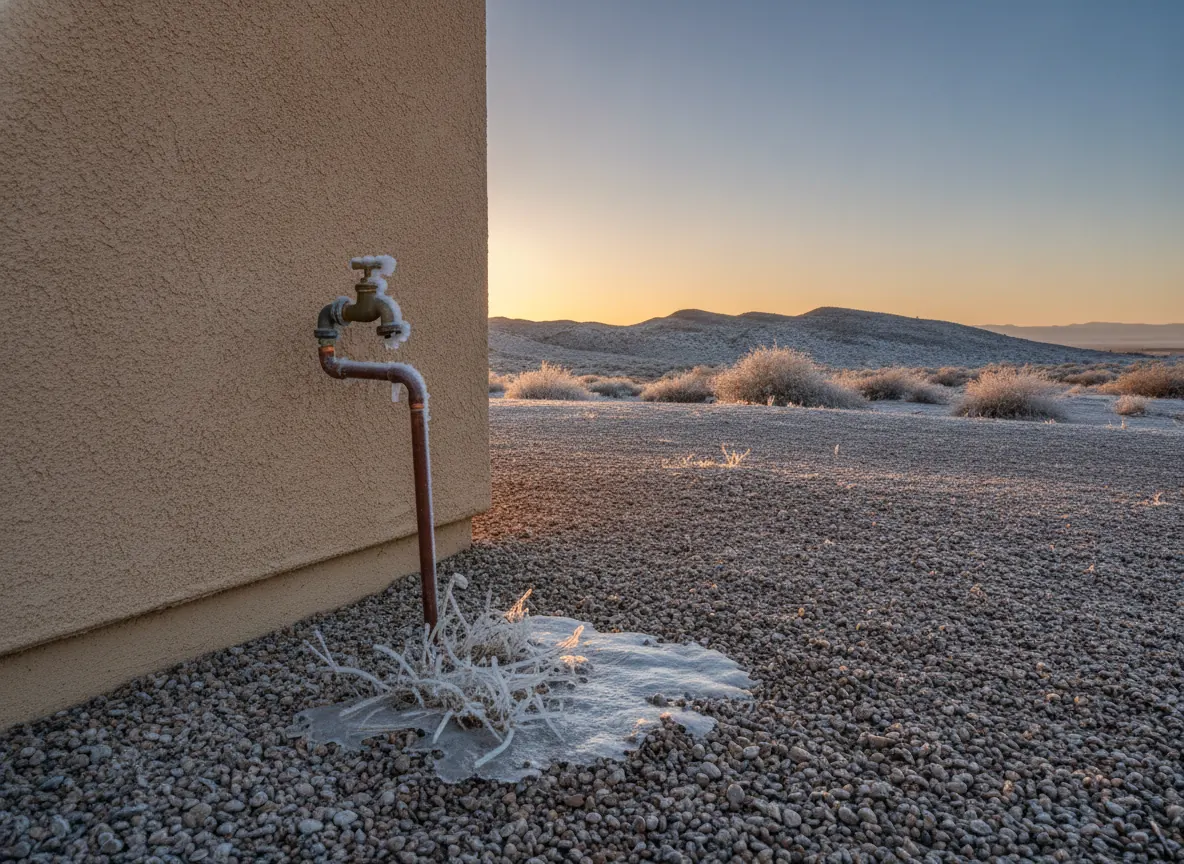
People don't think of the desert as pipe-freezing country, but Antelope Valley winter nights are cold. Clear skies let the day's heat escape fast, and by dawn the temperature can sit well below freezing. Pipes that never see a problem in July can split in January. This guide covers how often it freezes here, which pipes are most at risk, what to do the moment a pipe bursts, and who to call for the leak and for the water.
Do this first. Shut off the water at your main valve. Turn off power to wet areas only if you can reach the breaker panel without standing in water, and keep everyone out from under a sagging ceiling. Call your water provider if the leak is on their side of the meter. Photograph the damage before anything is moved or thrown out, then call your insurer.
How cold does it get in the Antelope Valley?
Lancaster averages about 68 nights a year at or below freezing, mostly from November through February (NOAA normals, Fox Field). December averages about 20 freezing nights there and January about 18. Palmdale Airport averages about 54 freezing nights a year. Tehachapi averages about 82 (NOAA normals, Tehachapi 4 SE), the coldest town in the area.
At Fox Field the median first fall freeze is around November 1 and the median last spring freeze is around April 3, so pipes are at risk for five months of the year. The lowest reading in the Fox Field record is 2°F, on December 24, 1984. On January 9, 2025, Fox Field dropped to 19°F. Snow happens too: in January 2011, as much as 8 inches was reported in Palmdale (NOAA Storm Events).
Why pipes burst in a freeze
Water expands as it freezes. When ice forms inside a pipe, it squeezes the water trapped between the ice and a closed faucet, and the pressure splits the pipe, often at a fitting or in a stretch you can't see. That's why many bursts aren't noticed until the afternoon, when the ice thaws and water starts pouring out of a wall or ceiling.
Pipes most at risk in a high-desert home:
- Hose bibs and exposed lines on north-facing walls
- Pipes in attics, garages, crawl spaces and exterior walls
- The water line to a rooftop swamp cooler, if your home has one
- Lines under mobile and manufactured homes, especially where the skirting is damaged
- Irrigation and backflow assemblies near the house
- Pipes in a vacant house or a room with the heat turned off
About 22% of Rosamond's homes are mobile homes (Census ACS 2020–2024), which can need different repair approaches and permits. If you live in one, check the skirting and the insulation on the supply lines before the first hard freeze. More local detail is on the Rosamond and Tehachapi pages.
How to protect pipes before a hard freeze
- Find your main shutoff valve now and make sure it turns.
- Disconnect garden hoses and cover outdoor faucets.
- Insulate exposed pipes in the garage, attic and crawl space.
- On the coldest nights, let a faucet on an outside wall drip and open the cabinet doors under sinks.
- If your home has a rooftop swamp cooler, shut off and drain its water line before winter (see the swamp cooler leak guide).
- Keep the heat on, even when you're away, and ask someone to check the house during a long trip.
If a pipe freezes but hasn't burst
If a faucet only trickles on a cold morning, a pipe may be frozen. Keep the faucet open, and warm the pipe slowly with a hair dryer or warm towels, working from the faucet back toward the ice. Never use an open flame or a torch. If you can't find the frozen section, or it's inside a wall, call a plumber. And keep the shutoff handy: a thawing pipe is often where a hidden split shows itself.
Plumber or restoration company: who to call
A burst pipe is usually two jobs. The plumber fixes the leak. A restoration company handles the water: it extracts standing water, opens wet ceilings or walls where needed, and dries the structure with air movers and dehumidifiers while tracking moisture readings until it's dry. In California, plumbing is its own CSLB license class (C-36), and repair work of $1,000 or more needs a licensed contractor.
Supply-line water usually starts clean (Category 1), which is the least expensive kind to dry. Water that sits for a day or more, or runs through insulation and flooring, can become dirtier, so act quickly. See burst and frozen pipe water damage and water extraction and mitigation for what the drying work involves.
Dry desert air helps, but it can't reach the inside of a wet wall or ceiling cavity. Material left wet for days can grow mold. More on mold after water damage.
Insurance for a burst pipe in California
Homeowners policies usually cover sudden and accidental water damage, such as a pipe that bursts in a freeze, while gradual leaks and wear are usually excluded. Policies differ, so read yours and call your insurer early. This is general information, not legal or insurance advice.
California homeowners have the right to choose their own licensed contractor; your insurer can't require you to use a particular company (Insurance Code §10103.5; 10 CCR §2695.9). If your own contractor's estimate is higher than your insurer's, California rules require the insurer to pay the difference, name a repairer who will do the work for its estimate, or adjust your contractor's estimate (10 CCR §2695.9(d)). Before repairs start, ask your insurer's adjuster whether they need to inspect first, take photos and keep receipts (California Department of Insurance).
If you rent, tell your landlord right away. The building and its insurance are usually the owner's responsibility.
What burst-pipe damage costs
| Item | Typical range |
|---|---|
| Pipe leak repair (a plumber, billed separately) | $630–$4,400 |
| Per sq ft: clean water (Category 1) | $3–$4 |
| Water mitigation (extraction and drying) | $4–$12 per sq ft |
| Nights and weekends | often 20–50% more |
The plumbing repair and the water cleanup are usually billed separately, and so is rebuilding drywall and flooring. Freezes tend to hit at night and on holidays, when rates are often higher. For a planning range, try the calculator in the water damage restoration cost guide for Lancaster, CA.
Before you sign
Check any contractor's license at cslb.ca.gov or call 800-321-2752 before you sign. Most home improvement contracts signed at your home come with a three-business-day right to cancel, or five days if you're 65 or older (Civil Code §1689.6). California caps a contractor's down payment at $1,000 or 10% of the contract, whichever is less (B&P §7159.5). Ask for a written scope, the drying plan, and copies of the moisture readings.
Frequently asked questions
Do pipes really freeze in the Antelope Valley?
Yes. Lancaster averages about 68 nights a year at or below freezing (NOAA normals, Fox Field), Palmdale Airport about 54 and Tehachapi about 82. Exposed pipes, attic and garage lines, and swamp cooler supply lines are the most likely to burst.
What should I do first when a pipe bursts?
Shut off the water at the main valve, turn off power to wet areas only if you can reach the panel without standing in water, and photograph the damage. Then call a plumber for the leak, your insurer, and a restoration company for the water.
Does homeowners insurance cover a frozen pipe burst?
Often, because policies usually cover sudden and accidental water damage. Gradual leaks and wear are usually excluded, and policies differ, so check yours. This is general information, not legal or insurance advice.
Will the dry desert air dry out my walls on its own?
Not reliably. Dry air helps once water is extracted, but it can't reach inside wall and ceiling cavities. A restoration company typically uses air movers and dehumidifiers and checks moisture readings until materials are dry.
Get quotes from local restoration companies
Antelope Valley Fire & Water Damage is a free quote service, not a restoration company or contractor, and it does not do cleanup, drying, mold work or repairs. Describe the damage once, and independent restoration companies serving Lancaster, Palmdale and the rest of the Antelope Valley can reply to you directly. You sign any contract directly with the company you choose and pay that company directly. Companies may pay to receive requests, and there is no obligation to hire anyone. Request free quotes, or call (877) 265-2390 to be connected with a local restoration company.